We're aware of the recent post from Lead Safe Mama regarding our Natural Face Sunscreen, Clear Zinc SPF 50 (50g), and we want to respond directly, openly, and with verified information.
At Little Urchin, product safety and transparency are non-negotiable. We take any such claims seriously and immediately initiated a thorough internal review to confirm the integrity and safety of our sunscreen.
What we've done immediately
Verified all internal documentation: We reviewed every batch record, Certificate of Analysis (CoA), and raw material specification for this product and all of our products.
All data confirmed full compliance with material heavy-metal impurity limits and manufacturing quality standards.
Confirmed supplier quality controls: Every raw material we use is accompanied by a supplier CoA, which often includes independent heavy-metal testing.
Our suppliers also provide written declarations confirming compliance with stringent international cosmetic safety regulations.
Commissioned independent testing: To ensure complete transparency, we commissioned additional third-party testing through ALS Laboratories, an ISO-accredited independent facility. The comprehensive heavy-metal analysis results came in below the claimed results, but also confirmed that all tested levels were well below internationally recognised safe limits for cosmetics.
Link to Independent Test
About the “Lead Safe Mama” article and graphic image
You may have seen a graphic claiming that our product contains high levels of lead, cadmium, and arsenic, shown in ppb (parts per billion) and compared to baby-food ingestion limits. Here’s why that information is misleading and not applicable to a topical sunscreen:
1) No laboratory or method disclosed
The image doesn’t name the testing lab, confirm accreditation, or describe how the samples were prepared or analysed. Without this basic information, the data cannot be verified or replicated.
2) Units are presented to appear more alarming
The numbers are given in parts per billion (ppb), which are extremely small quantities.
For context
- 1,311.6 ppb lead = 1.31 ppm
- 337.9 ppb cadmium = 0.34 ppm
- 229.6 ppb arsenic = 0.23 ppm
- Mercury was non-detect (< 5 ppb)
Reporting results in ppb instead of ppm makes the numbers look 1,000 times larger than they are — a technique that can create unnecessary alarm.
The standard measurement for cosmetics is ppm.
3) Food limits don’t apply to skincare
The comparison used in the image comes from proposed action levels for ingested baby food, not for cosmetics. Sunscreens are not eaten, and dermal absorption of trace metals from mineral ingredients is scientifically proven to be negligible. Comparing food safety limits to a skin-applied sunscreen is scientifically invalid and misleading.
4) Real safety standards for cosmetics
Global regulatory agencies and accredited laboratories apply well-established impurity benchmarks for non-ingested cosmetic and skincare products. These limits, recognised across the U.S., European Union, and Australia, set strict thresholds for unavoidable trace metals that can naturally occur in raw materials:
Lead (Pb): ≤ 10 ppm
Cadmium (Cd): ≤ 5 ppm
Arsenic (As): ≤ 3 ppm
Mercury (Hg): ≤ 1 ppm
These levels represent trace, non-toxic amounts that are well below any threshold of concern. Even the figures presented by Lead Mama — which, based on our internal documentation, are not representative of our products — fall comfortably within internationally accepted safety limits.
5) Understanding trace elements in everyday materials
It’s important to understand that lead and other trace metals are naturally occurring elements found everywhere in the environment — in soil, water, air, dust, and in the minerals used to make many everyday materials.
Because these elements exist naturally in the earth’s crust, minute quantities can be detected in almost all manufactured goods, including glass, ceramics, pigments, paint, stainless steel, electronics, and cosmetics. This is true even for products made to the highest food- or pharmaceutical-grade standards.
Regulatory authorities and accredited laboratories around the world recognize this scientific reality and set impurity thresholds accordingly. These limits acknowledge that while absolute zero for naturally occurring metals is impossible, safe and negligible levels are clearly defined and tightly controlled.
Our formulations remain well below these international limits, and every product in our range is fully compliant, safe, and rigorously tested.
6) Community discussions highlight fear-based messaging and misinformation
Members of online communities such as Reddit’s “Moderately Granola Moms” have discussed these same claims and raised serious concerns about Lead Mama’s approach. Many users — including parents, scientists, and health-conscious consumers — have pointed out that:
- The posts often use fear-based and sensational language to alarm readers without offering context or verifiable data.
- Lead Mama’s testing lacks transparency, peer review, or independent verification, yet results are presented as absolute facts.
- Some community members observed that the platform appears to profit from fear, driving engagement and affiliate sales through exaggerated claims.
- These behaviors have led to widespread skepticism and frustration from readers who value evidence-based, balanced information.
This community feedback reflects what we also see across scientific and regulatory circles: advocacy is valuable, but fear-driven misinformation helps no one — especially when it damages public trust in safe, well-regulated products.
Our position
We have commissioned and received independent, accredited laboratory results confirming that all trace elements are well below international safety limits. Our internal review, supplier quality checks, and third-party testing collectively reaffirm that our Natural Face Sunscreen, Clear Zinc SPF 50 — and all Little Urchin products — are safe, compliant, and produced to the highest quality standards.
The claims circulating online misapply food-based standards to a topical skincare product, use inflated units to exaggerate values, and fail to disclose any credible testing credentials.
At Little Urchin, we stand by our values of scientific integrity, transparency, and safety — the very principles on which our company was founded. We take these claims seriously, but we will always respond with verified facts, accredited testing, and open communication, never fear or misinformation.
Thank you for your continued trust and understanding. If you have further questions, please don’t hesitate to reach out, we’re always happy to help.
 Kids Natural Clear Zinc Sunscreen SPF 50, 300ml
 KIDS Natural Clear Zinc Sunscreen SPF 50, 100g
 Natural Clear Zinc Sunscreen SPF 50, 300ml
 Natural Clear Zinc Sunscreen SPF 50+, 100g
 Natural Face Sunscreen SPF 50+ Clear Zinc, 50g
 Natural Face Sunscreen SPF 50+ Medium / Light Tinted Zinc, 50g
 Natural Clear Zinc Sunscreen SPF 30, 100g
 Natural Zinc Stick Clear, SPF 50+
 KIDS Natural Zinc Stick Clear, SPF 50+
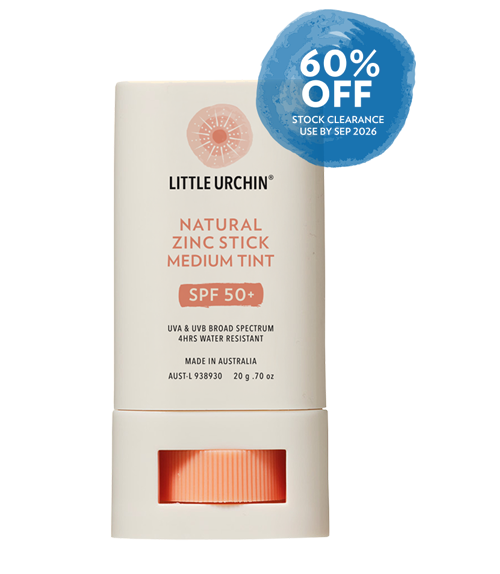 Natural Zinc Stick, Medium Tint, SPF 50+
 BABY Natural Clear Zinc Sunscreen SPF 50, 100g
 Blue Natural Coloured Zinc Stick, SPF 50+
 Red Natural Coloured Zinc Stick, SPF 50+
 BABY Natural Zinc Stick Sunscreen, SPF 50


